

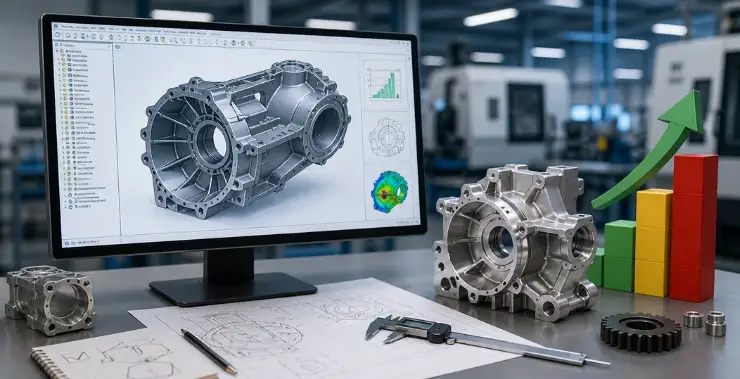
Most product failures don’t happen on the factory floor. They happen weeks or months earlier – on a CAD screen, in a design review meeting, or in a decision to use a tighter tolerance than the process can reliably hold.
That’s exactly what design for manufacturability (DFM) is built to prevent.
If your team is regularly dealing with last-minute engineering changes, higher-than-expected production costs, or parts that are difficult to assemble consistently, there’s a good chance DFM principles aren’t being applied early enough.
What Is Design for Manufacturability – The Short Answer
Design for manufacturability (also called DFM or design for manufacturing) is an engineering approach where a product is designed with its production process in mind from day one.
Instead of handing a finished design to the manufacturing team and hoping it goes smoothly, DFM brings those manufacturing considerations into the earliest stages of product development.
The result? Fewer surprises. Lower costs. Faster time to market.
It covers decisions around:
- Part geometry and complexity
- Tolerances and surface finishes
- Material selection
- Number of components in an assembly
- Ease of automation and machine processing
DFM is not a one-size-fits-all checklist. The right approach differs based on whether you’re working with injection moulding, sheet metal, CNC machining, casting, or another process entirely.
Why Manufacturing Problems Start in the Design Room
Here’s something most engineers know but often underestimate: roughly 70–80% of a product’s total manufacturing cost is locked in during the design phase.
By the time a part reaches the shop floor, there’s very little room to reduce cost without a redesign. That redesign – called an engineering change order (ECO) – is expensive, time-consuming, and disruptive.
Studies in product development have long shown that fixing a design problem costs significantly more at each successive stage. A change made during concept design might cost a few hours of an engineer’s time. The same change made during production can cost tens of thousands in downtime, scrapped tooling, and delayed shipments. This is often referred to as the Rule of 10 in product development.
DFM helps you catch and fix those problems while a change still costs almost nothing.
The Core Principles Behind DFM
Five widely recognised principles guide good DFM practice:
- Simplification: Reduce the number of parts wherever possible. Fewer components mean fewer assembly steps, fewer potential failure points, and lower inventory costs.
- Standardisation: Use off-the-shelf components, standard hole sizes, and common fasteners rather than custom-made equivalents. It reduces procurement costs and speeds up assembly.
- Tolerance management: Tight tolerances cost money. Every time you specify a tolerance tighter than what the process can naturally achieve, you’re adding inspection time, scrap risk, and sometimes specialised machining. Apply tight tolerances only where function genuinely requires it.
- Material selection: The cheapest material is rarely the best choice – but neither is over-specifying. DFM encourages choosing materials that work well with your intended manufacturing process, reducing waste and processing difficulty.
- Error-proofing (Poke Yoke): Design parts so they can only be assembled the right way. Asymmetrical features, directional fasteners, and locating pins that prevent incorrect orientation all reduce assembly defects without adding inspection steps.
How DFM Cuts Costs at Every Stage
DFM doesn’t save money in just one area – its impact runs across the entire production lifecycle.
Reduced tooling costs: When parts are designed with a specific manufacturing process in mind (e.g., avoiding undercuts in injection moulding), tooling is simpler and cheaper to produce.
Lower material waste: Poorly designed parts often require more raw material than needed or generate excessive scrap during machining. Good DFM optimises geometry to minimise both.
Shorter cycle times: Simpler designs process faster. Fewer assembly steps mean lower labour costs and higher throughput.
Fewer defects and rework: Parts that are designed to be easy to manufacture are also easier to manufacture consistently. That directly reduces defect rates and the cost of rework or scrap.
Fewer engineering change orders: One of the highest hidden costs in product development is redesigning a part after tooling has already been ordered. DFM significantly reduces ECO frequency by catching issues early.
DFM in Practice – Real Industries, Real Results
DFM is used across a wide range of sectors. Here are a few practical examples:
Automotive: Car manufacturers routinely redesign door handles, brackets, and interior components to reduce part count. A bracket that was previously five separate stamped pieces gets redesigned as a single formed part – saving assembly time on every vehicle produced.
Consumer Electronics: Smartphone manufacturers work hard to standardise internal connectors, screw sizes, and PCB dimensions across product lines. This makes production faster and component sourcing more predictable.
Industrial Equipment: A pump housing originally designed with multiple machining operations gets redesigned to be sand cast with minimal secondary machining – cutting unit cost by a meaningful margin at volume.
These aren’t edge cases. They’re the result of engineers asking one question earlier in the process: Can this be made more easily?
How CAD Tools Like PTC Creo Make DFM Practical
DFM works best when it’s embedded in the design environment – not treated as a separate review step at the end of the process.
This is where modern CAD platforms make a real difference. PTC Creo, for example, includes tools that allow engineers to evaluate part feasibility, assess assembly complexity, and flag cost-driving features directly within the 3D design environment.
When DFM analysis is integrated into the CAD workflow:
- Engineers see manufacturability feedback while still actively designing
- Design iterations happen faster because there’s no need to export files or wait for a separate review
- Issues are flagged against hundreds of manufacturing rules covering machining, sheet metal, injection moulding, and casting
For teams working with PTC Creo, tools like DFMPro sit inside the platform and automate much of the design-review process – reducing what used to take days of back-and-forth into a process that runs in minutes.
CreoTek India, as an authorised PTC partner, helps engineering teams in India set up and get the most out of these capabilities.
DFM vs. DFA – What’s the Difference?
These two terms often appear together and are sometimes confused.
DFM (Design for Manufacturability) focuses on how individual parts are made – geometry, material, tolerances, and the manufacturing process.
DFA (Design for Assembly) focuses on how those parts come together – the number of assembly steps, ease of handling, and whether automation is feasible.
In practice, they’re closely related and are often addressed together under the broader label DFx (Design for Excellence). A product designed well for manufacturing but poorly for assembly will still have high production costs, just further down the line.
Good product development teams consider both simultaneously.
Common DFM Mistakes Engineers Make
Even experienced teams fall into predictable traps:
- Over-tolerancing – specifying tighter tolerances than the function requires, because it feels safer
- Using custom parts when standard ones would work – adds cost and lead time for no real gain
- Designing in isolation – engineering and manufacturing teams not communicating until the design is nearly finalised
- Ignoring the manufacturing process – designing a part that’s geometrically correct but practically difficult or expensive to produce with the available equipment
- Skipping DFM reviews – treating manufacturability as a box to tick rather than an ongoing design consideration
Most of these mistakes are avoidable with the right tools and a process that includes manufacturing input early.
Is DFM Worth It for Smaller Manufacturers?
A common assumption is that DFM is only worth the effort for high-volume production runs. That’s not quite right.
Even at relatively low volumes – say, a few hundred units a year – the cost of a single late-stage ECO can easily exceed the time investment of running a proper DFM review upfront.
For startups and mid-sized manufacturers in India especially, where production costs and time-to-market directly affect competitiveness, getting DFM right early can be the difference between a product that’s commercially viable and one that isn’t.
The good news is that modern CAD-integrated DFM tools have made the process far more accessible than it used to be. You don’t need a dedicated DFM specialist – you need a design environment that surfaces manufacturability issues as part of the normal design workflow.
Final Thoughts
Design for manufacturability isn’t about limiting creativity or constraining engineers. It’s about making sure the product you’re designing can actually be built – reliably, efficiently, and at a cost that makes commercial sense.
The earlier DFM principles are applied, the more impact they have. And with the right CAD tools in place, applying them doesn’t have to slow the design process down at all.
If your team is currently treating manufacturability as an afterthought, it’s worth asking what that’s costing you – in rework, in ECOs, and in the production inefficiencies that follow.
CreoTek India is an authorised PTC partner, helping engineering and manufacturing teams across India implement CAD, PLM, CAE, and simulation solutions. Contact us to learn how tools like PTC Creo can support better DFM practices in your product development process.