

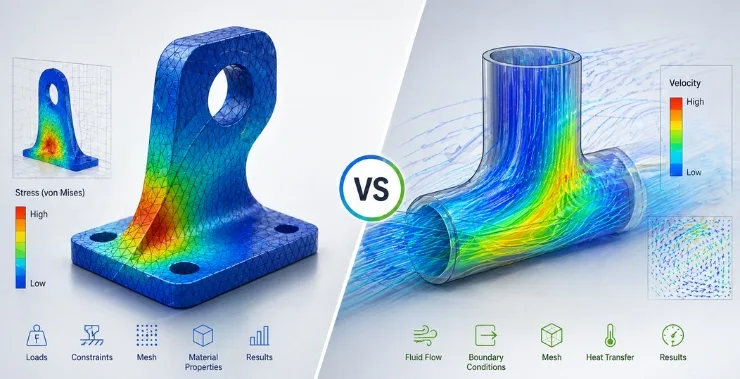
CFD vs FEA – engineers debate this more than you’d think. Not because the answer is complicated, but because teams often jump into simulation without asking the most basic question first: what exactly are you trying to find out?
Get that wrong and you’ll spend weeks setting up a simulation that can’t actually answer your question.
CFD vs FEA – Two Methods, Two Completely Different Problems
FEA (Finite Element Analysis) deals with solid structures. You want to know if a bracket will crack under load, how heat spreads through a metal housing, or whether a component will fail under repeated vibration – FEA is what you reach for.
It breaks a solid geometry into thousands of small elements, applies your material properties and loads, and tells you where stress concentrates and how the part deforms.
CFD (Computational Fluid Dynamics) does something entirely different. It models how liquids and gases move – and how that movement interacts with the surfaces around them. Airflow over a car body, cooling inside a data center, combustion gases inside an engine – those are CFD problems.
The math underneath is different too. CFD solves the Navier-Stokes equations, which govern fluid motion. Standard FEA solvers weren’t built for that, and if you try to push FEA into heavy fluid problems, you’ll run into convergence issues fast.
FEA Is the Right Call When Your Problem Involves Solids
Most mechanical engineering teams spend the majority of their simulation time here. FEA handles:
- Static load analysis – will this part hold under the force applied to it?
- Fatigue and vibration – will it survive repeated loading over time?
- Thermal stress in solids – how does heat expand or distort this component?
- Impact and crash scenarios – what happens in a sudden dynamic event?
- Nonlinear material behavior – rubber, composites, welds, formed sheet metal
Tools like MSC Nastran cover linear and nonlinear structural problems across industries. MSC Marc goes further into contact mechanics and large deformations – useful for forming, sealing, and assembly simulation.
One thing that’s changed over the past decade: FEA has gotten a lot faster and more accessible. What once took a specialist and a dedicated workstation now runs inside CAD environments. Creo Simulation Live pushes FEA results in real time as you change geometry, which genuinely changes how early in the process engineers can catch problems.
CFD Earns Its Place in Fluid-Dominated Problems
If your question involves flow, pressure drop, heat transfer through a moving fluid, or aerodynamics, CFD is the only tool that gives you reliable answers. Specific situations where teams use it:
- Airflow over vehicle exteriors, wings, or turbine blades
- Cooling system design – forced convection, liquid cooling loops, electronics thermal management
- Combustion analysis inside engines or furnaces
- Pipe network pressure drop and flow distribution
- Weather sealing performance on automotive components
Hexagon’s Cradle CFD handles these types of problems well – from rotating machinery to free surface flows and thermal-fluid coupling. It’s worth knowing upfront that CFD runs are typically heavier computationally than equivalent FEA jobs. Longer solve times, more sensitive meshing requirements. Budget that into your project schedule.
Side-by-Side: Where Each One Fits
| FEA | CFD | |
| Studies | Solid structures | Liquids and gases |
| Outputs | Stress, strain, deflection | Velocity, pressure, flow patterns |
| Core equations | Structural elasticity | Navier-Stokes |
| Thermal coverage | Conduction in solids | Convection in fluids |
| Compute demand | Moderate | High |
| Common industries | Automotive, aerospace, manufacturing | Energy, HVAC, aerospace, and chemical |
Some Problems Need Both
This comes up in real projects more than the textbooks suggest. A few examples:
An aerospace team calculates aerodynamic pressure on a wing surface using CFD, then passes those pressure loads into an FEA model to check whether the wing structure can handle them. Neither tool alone gives the full picture.
Civil engineers do something similar with bridge piers – CFD models the water forces, FEA checks whether the pier’s structure survives those forces over time.
In medical devices, blood flow and vessel wall stress need to be analyzed together. That’s where platforms built for coupled analysis come in. MSC Cosim connects multi-domain simulations so results from one physics feed directly into the next, without manual data transfer steps.
This kind of coupled workflow – often called multiphysics simulation – used to require serious specialist knowledge to set up. Modern software has made it more approachable, but it still demands that someone on the team understands both methods well enough to know which results are inputs to which analysis.
Choosing the Right One Starts With One Question
Before picking a tool, ask: what is the unknown I’m trying to solve for?
If it’s a structural question – deformation, stress, failure mode, resonance – use FEA. If it’s a fluid question – flow rate, pressure loss, convective heat transfer, drag – use CFD. If your design involves both solid and fluid behavior interacting with each other, plan for both from the start rather than trying to bolt on the second one later.
As Engineering.com notes, experienced simulation engineers follow a straightforward rule: CFD for fluid-primary problems, FEA for structural-primary ones. The tricky cases are the coupled ones – and those need deliberate planning, not an afterthought.
Getting the Toolset Right for Your Team
Most engineering teams don’t need to choose permanently between CFD and FEA. They need both at some point, and the question is usually about which to invest in first and how to build a workflow that doesn’t require starting from scratch every time a new problem type comes in.
Whether you’re running structural simulation through Hexagon MSC tools, integrating live simulation into your Creo design process, or evaluating a full CAE software setup for your organization, getting the method matched to the problem saves time at every stage.
If you’re figuring out which simulation tools make sense for your current projects, the team at CreoTek India can help you map your problem types to the right software.