

Mechanical engineers have always worked within limits – weight, stress, material cost, and manufacturing feasibility. The question has always been: how do you get the best possible design given those limits? What is generative design, and does it actually answer that question better than the methods engineers have relied on for decades?
The short answer: yes, in many cases. The longer answer is more interesting.
Generative design is a process where an engineer sets the requirements – load conditions, materials, manufacturing method, safety constraints – and an AI-driven algorithm produces multiple design options that meet those requirements. Not one design. Many. Some of them look nothing like what a human would sketch. That’s often the point.
What Is Generative Design – and How Does It Actually Work?
At its core, generative design uses algorithms – often machine learning-based – to explore a design space automatically. The engineer defines:
- The space the part must fit within (design envelope)
- Forces and loads it must handle
- Materials available
- Manufacturing methods (CNC, casting, 3D printing, etc.)
- Weight or cost targets
The software then runs through thousands of possible configurations and surfaces the ones that best satisfy those inputs. Engineers don’t draw a shape and then test it. They define what the shape needs to do, and the software figures out what the shape should be.
That shift – from “draw then test” to “define then discover” – is what makes generative design different from everything that came before it.
How It Differs from Traditional CAD
In traditional CAD, a designer starts with a concept in mind. They model it, run stress simulations, find weak points, modify the geometry, and repeat. The design improves with each cycle, but it only improves within the boundaries of what the designer already imagined.
Generative design has no such starting point. It isn’t refining a human concept. It’s searching the entire possibility space from scratch.
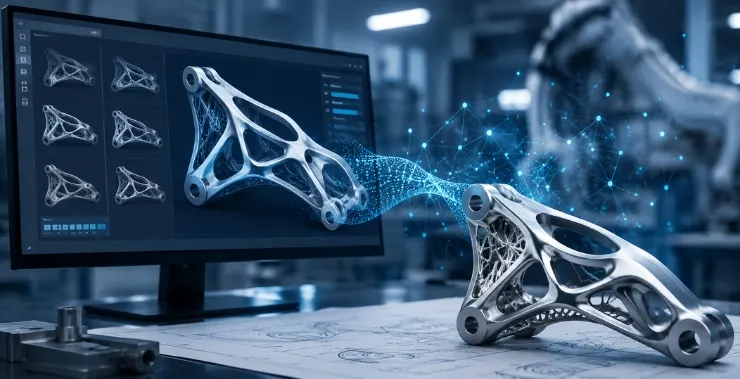
This matters because human designers naturally converge on familiar shapes – shapes that are easy to manufacture with traditional methods, shapes that look like previous parts, shapes that feel intuitively correct. Generative design doesn’t have those instincts, which means it occasionally produces geometries that look almost biological: latticed interiors, asymmetric load paths, hollow pockets where solid material used to sit.
Those odd-looking shapes often turn out to be stronger and lighter than anything a designer would have drawn manually.
The Role of AI in Generative Design
AI does two things in generative design that traditional software couldn’t do well.
First, it generates options at a scale that’s not feasible manually. A topology optimization run from the 1990s might explore a few thousand configurations over several hours. Modern AI-driven generative design tools can evaluate far more permutations in the same time, using machine learning models trained on previous design data to narrow the search toward better solutions faster.
Second, AI learns across iterations. Traditional algorithms apply fixed rules. Machine learning models adapt – they get better at predicting which design directions are worth exploring based on what they’ve already evaluated.
Autodesk’s research on generative design has shown parts produced through AI-driven generative processes can be up to 50% lighter while maintaining or exceeding the structural performance of their manually designed counterparts.
Topology Optimization vs Generative Design
These two terms get used interchangeably, but they’re not the same thing.
Topology optimization starts with an existing geometry and removes material from it – like a sculptor taking a block of marble and carving away everything that isn’t the statue. It converges on one optimized version of a given starting design.
Generative design doesn’t start with a shape at all. It generates many possible shapes and presents them as options. The engineer selects the most appropriate one based on cost, manufacturing preference, aesthetics, or other factors.
Think of topology optimization as a refining tool and generative design as an exploring tool. In practice, many modern platforms – including PTC Creo’s Generative Design Extension – combine both.
Real Benefits Mechanical Engineers Are Seeing
The benefits of generative design aren’t theoretical at this point. They’re showing up in production parts across aerospace, automotive, and industrial equipment.
Weight reduction without compromising strength: Parts designed with AI-driven tools routinely come out 20–40% lighter. In aerospace, every gram matters. In automotive, lighter parts mean better fuel efficiency. This isn’t done by guessing – it’s done by letting the algorithm find load paths that use material only where it’s actually needed.
Faster design cycles: Engineers spend less time manually iterating and more time evaluating options the software has already generated. The early stages of design, which used to involve weeks of back-and-forth, have compressed significantly.
Better fit for additive manufacturing: Generative design often produces geometries that can’t be machined conventionally but work perfectly for 3D printing. The two technologies were made for each other: generative design creates complex internal structures that additive manufacturing can actually build.
Reduced material waste: When a part only contains the material it needs, there’s less waste in manufacturing. For expensive metals like titanium or specialty alloys, this isn’t a small consideration.
More options for engineers to evaluate: Rather than arriving at a design review with one proposal, an engineer can bring five or ten structurally valid options with different weight-cost trade-offs. That changes the conversation at the design stage.
Where Generative Design Is Being Used Right Now
A few sectors have adopted generative design faster than others, and for understandable reasons.
Aerospace was an early adopter because weight reduction directly affects fuel burn and payload capacity. Airbus has used generative design for cabin partitions. The results – latticed structures that look more like bone than metal – are lighter and equally strong.
Automotive teams use it for brackets, mounts, structural supports, and chassis components. When manufacturers are trying to reduce vehicle weight across hundreds of components, saving even a few grams per part adds up quickly across a production run.
Industrial machinery designers use it for custom brackets, fixtures, and housings where off-the-shelf components don’t exist. Generative design fills the gap between “we need something custom” and “we have time to design it from scratch.”
Medical devices benefit from generative design when parts need to be both strong and very light – orthopedic implants, in particular, often use biologically-inspired lattice structures that happen to be what generative algorithms produce naturally.
Which Tools Support Generative Design?
Not all CAD platforms have caught up with this technology. The ones that have are worth knowing.
PTC Creo includes a Generative Design Extension (GDX) and a Generative Topology Optimization extension (GTO). Engineers already working inside Creo can access AI-driven design generation without switching platforms. This matters a lot for teams with established workflows – you’re not rebuilding your design process, you’re adding a capability to it. CreoTek India is an authorized PTC channel partner, so if you’re evaluating Creo’s generative design tools, we can walk you through a live demo.
Autodesk Fusion has generative design built in and is often the first platform engineers encounter when learning about this technology. It’s accessible and well-documented.
Hexagon MSC Software provides simulation tools – including finite element analysis through MSC Nastran and multi-body dynamics through MSC Adams – that work alongside generative design workflows. Running generated designs through structural simulation validates them before any physical prototype gets made.
Siemens NX and CATIA (Dassault Systèmes) both have generative and topology optimization capabilities, primarily used in automotive and aerospace OEM environments.
What This Means for Engineers in India
Indian manufacturing is in the middle of a significant shift. The push toward lighter components, faster product development, and compliance with international quality standards is putting pressure on engineering teams that are still relying on traditional CAD workflows.
Generative design isn’t a replacement for engineering judgment – it’s a way to give that judgment more options to work with. An engineer who understands materials, manufacturing constraints, and application requirements will always make a better decision than one who doesn’t. What generative design does is make sure that the decision is made with the best possible options on the table.
For companies in Delhi NCR and across India’s manufacturing corridor, the tools are available now. The question is whether teams are set up to use them effectively – the right software, the right training, and integration with existing simulation workflows.
FAQs
Does generative design require 3D printing to be useful?
No. Generative design tools let you specify your manufacturing method – CNC milling, casting, sheet metal, or additive manufacturing – and the algorithm constrains its outputs accordingly. You get design options that are manufacturable with whatever process you actually use.
Is generative design the same as AI-generated design?
They overlap but aren’t identical. Generative design is a specific methodology that uses algorithms (often AI-based) to produce optimized designs from defined constraints. AI-generated design is a broader term that can include things like image generation or style transfer, which don’t necessarily produce structurally valid engineering outputs.
How much engineering knowledge do you need to use generative design tools?
Quite a bit, actually. The quality of the output depends almost entirely on the quality of the inputs. An engineer who doesn’t correctly define load cases, boundary conditions, and manufacturing constraints will get outputs that look interesting but aren’t useful. Generative design amplifies good engineering thinking – it doesn’t substitute for it.
Can generative design work inside existing CAD tools?
Yes, for the platforms that support it. PTC Creo, Autodesk Fusion, and Siemens NX all have generative design capabilities that work within their existing environments. You don’t necessarily need a separate specialist tool.