

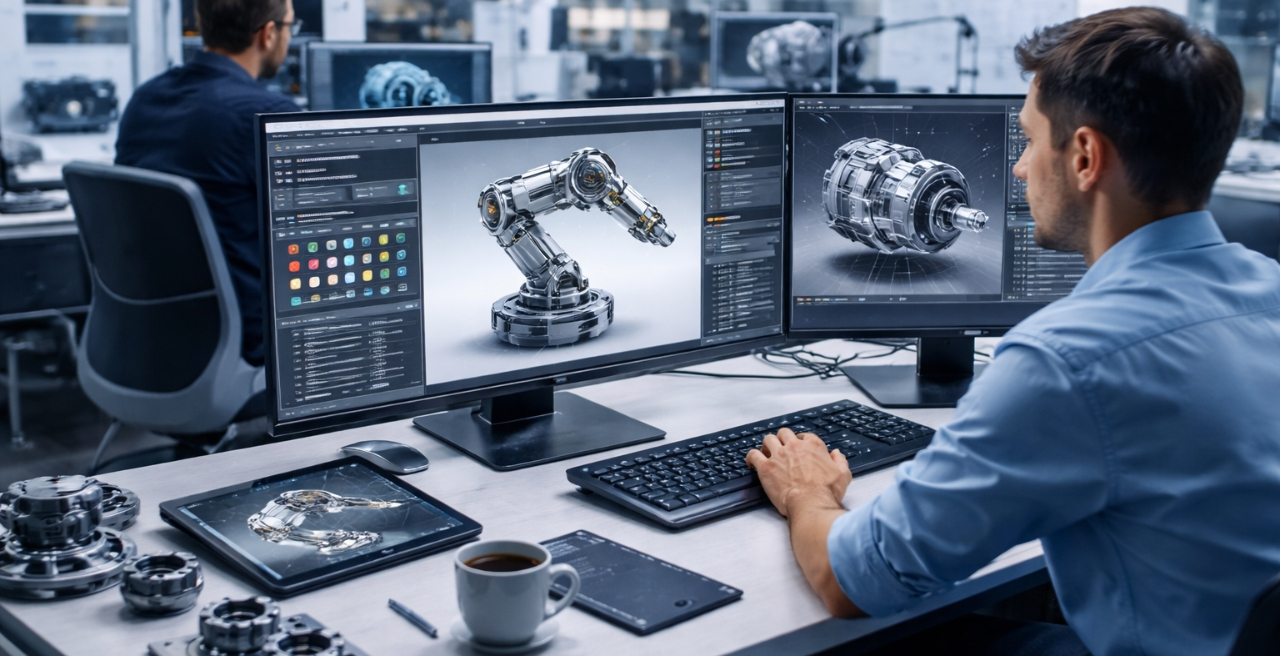
Product Visualization Software has become the cornerstone of modern industrial design, bridging the gap between complex engineering data and stakeholder expectations.
In an era where “seeing is believing,” the ability to transform a raw CAD file into a photorealistic digital twin is no longer a luxury-it’s a competitive necessity. For Indian manufacturers, this technology represents the fastest route to global quality standards.
The shift toward digital-first workflows is accelerating. Companies that once relied on physical prototypes now find that virtual models are more flexible, cheaper, and faster to produce. By adopting high-end rendering, you aren’t just making a picture; you are creating a versatile digital asset.
Product Visualization Software: Driving Efficiency in Modern Engineering
The evolution of design has moved far beyond simple 2D blueprints. Today, Product Visualization Software serves as a vital bridge between the engineering department and the rest of the organization. When engineers use tools like KeyShot or PTC Creo, they aren’t just looking at geometry; they are looking at the future of the product in its intended environment.
- Real-time Feedback: Apply materials and lighting to see how a product reacts to its surroundings.
- Design Validation: Identify aesthetic imbalances or ergonomic issues that are invisible in standard CAD views.
- Enhanced Collaboration: Break down the communication barrier between technical teams and non-technical stakeholders.
- Digital Twins: Create an exact visual replica that mimics the physical properties of the final product.
By integrating these tools, the design cycle becomes iterative rather than linear. You no longer have to wait for a build to see a flaw.
Key Benefits for the Manufacturing Sector
Integrating 3D rendering for manufacturing into your workflow offers more than just “pretty pictures.” It is a strategic move that directly impacts the bottom line and operational agility.
- Accelerated Time-to-Market: Marketing teams can begin creating catalogues while the product is still in engineering.
- Drastic Cost Reduction: Minimize the need for expensive physical prototypes and studio photography.
- Unlimited Customization: Show clients thousands of color and material configurations without manufacturing a single part.
- Global Competitiveness: Present your designs with the same high-fidelity quality as top-tier international brands.
This efficiency is especially crucial for SMEs. This efficiency enables smaller firms to outperform their competitors by showcasing world-class visuals during the bidding process.
Enhancing the Sales and Marketing Funnel
Designing a part is not the end of modern manufacturing; it concludes with its sale. Photorealistic engineering models transform the sales teams’ approach.
- Interactive Sales Tools: Use 3D renders in web configurators so customers can “build” their products online.
- Trade Show Advantage: Display large-scale industrial machinery on a tablet using AR and high-quality rendering.
- Pre-Sales Success: Secure orders before production begins by showing investors exactly what the final product will look like.
When a customer can see the metal’s texture and the glass’s reflection, their confidence in the product skyrockets.
Must-Have Features in Engineering Visualization Tools
To truly benefit an engineering workflow, the tool must handle the complexity of industrial data. Not all software is built for the rigours of heavy engineering.
- Seamless CAD Integration: Look for “Live Linking” features. If you change a bolt in your CAD software, the render should update automatically.
- Material Accuracy: Use libraries with scientifically accurate refractive indices and surface textures.
- High-Performance Rendering: The software should leverage both CPU and GPU to handle large assemblies smoothly.
- Cloud Collaboration: The ability to share 3D scenes with remote teams for instant feedback and approval.
CAD visualization is only as effective as the data it can handle. Professional-grade tools ensure that “heavy” files don’t slow down your creative process.
Overcoming Traditional Manufacturing Hurdles
Traditional prototyping is often the biggest bottleneck in production. It is slow, expensive, and rigid. Digital prototyping solves these issues by allowing for “fail-fast” scenarios.
- Environmental Testing: Simulate how different lighting conditions (sunlight vs. factory floor) affect product visibility.
- Material Exploration: Test expensive materials like carbon fibre or specialised alloys virtually before purchasing.
- Assembly Instructions: Use 3D visuals to create clearer, easier-to-follow manuals for the shop floor.
By moving these steps into a virtual environment, the risk of “rework” is significantly mitigated.
Why CreoTek Recommends Industry-Leading Solutions
At CreoTek India, we understand that the right software can transform a business. We specialise in providing tools like KeyShot and the PTC suite, which are globally recognised for their power.
- Expert Support: We don’t just sell software; we provide the roadmap for implementation.
- Tailored Training: Ensure your team masters real-time 3D rendering to maximize your ROI.
- Industry Expertise: We understand the specific needs of the Indian manufacturing landscape.
Our goal is to help you move from “drawing” to “visualizing” with a minimal learning curve, making the software an extension of your team’s creativity.
Conclusion
In summary, Product Visualization Software is the ultimate tool for both innovation and sales. It empowers your engineers to design better products and enables your sales team to close deals faster.
In the fast-paced world of manufacturing, being able to show a finished product before it exists is the ultimate competitive advantage.
Investing in these tools today ensures your brand is ready for the digital-first marketplace of tomorrow.