

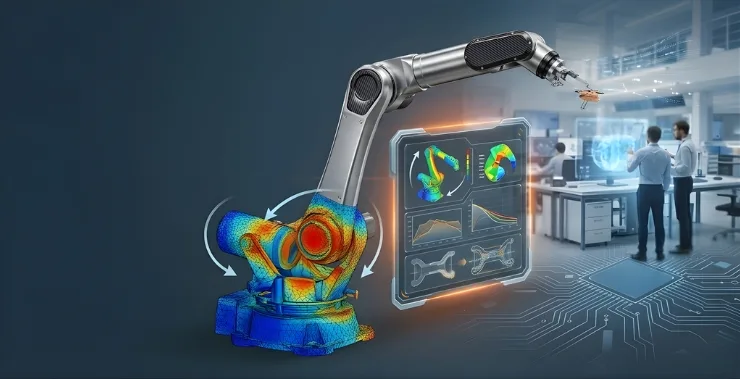
Digital Engineering Transformation is no longer a futuristic concept; it is the current benchmark for global manufacturing excellence. In an era where speed-to-market defines success, traditional “design-build-test” cycles are becoming a major bottleneck. Relying solely on physical prototypes is slow, expensive, and leaves very little room for error during the final stages of production.
The answer is to include high-fidelity Multibody Dynamics (MBD) in the early stages of the product development lifecycle.
Companies can make a seamless digital thread that links conceptual design to functional performance by using top-of-the-line tools like MSC Adams.
Engineers can find system-level problems long before a single part is made by switching from physical hardware to virtual prototyping.
Digital Engineering Transformation through Multibody Dynamics
Digital Engineering Transformation works best when you can guess how a product will work in the real world. Traditional CAD gives you a static view of the geometry, but Multibody Dynamics (MBD) makes those models come to life. It takes into account how moving parts interact with each other, such as friction, joints, and flexible bodies.
This change marks a big change from “component-level” thinking to “system-level” analysis. Engineers can simulate the whole assembly, like a vehicle suspension or a high-speed packaging robot, instead of just testing one bracket or bolt on its own.
With Digital Twin engineering, businesses can fine-tune performance parameters in a safe virtual environment, making sure that the final product meets all safety and durability standards.
Also, this method lets you run “what-if” scenarios that would be too risky or impossible to do in a real lab. To learn about failure modes, engineers can push a digital model to its limit.
This level of understanding is what makes modern Product Lifecycle Management (PLM) work. It makes sure that every design choice is based on accurate data.
The Role of MSC Adams in the Modern Engineering Workflow
MSC Adams stands as the industry standard for Multibody Simulation (MBS). It allows engineers to build and test functional virtual prototypes of complex mechanical systems. Unlike basic simulation tools that focus on static stresses, Adams calculates the loads and forces moving through a system with extreme precision during dynamic motion.
Key capabilities that drive this workflow include:
- System-Level Modeling: Go beyond individual parts to see how the entire machine functions under load.
- Flexible Body Integration: Combine Finite Element Analysis (FEA) with MBD to see how parts deform during high-speed motion.
- Control System Co-simulation: Integrate mechanical models with hydraulic or electronic control systems (Co-simulation with tools like MATLAB/Simulink).
- Load Prediction: Accurately predict component loads for downstream durability and fatigue analysis, reducing the need for over-engineering.
- Vibration Analysis: Identify resonance and noise issues (NVH) early in the design phase to improve user comfort and product longevity.
By using MSC Adams, the engineering team can move away from “trial and error” and toward a “correct-by-design” methodology. This significantly reduces the engineering change orders (ECOs) that typically plague the later stages of a project.
Key Benefits of MSC Adams for Digital Transformation
Adopting a simulation-led design approach offers measurable competitive advantages. By moving testing to the “left” of the project timeline, commonly known as front-loading, engineers can achieve the following:
- Reduced Prototyping Costs: Eliminate the need for multiple expensive physical iterations by “failing fast” in the digital space.
- Enhanced Product Reliability: Test environmental conditions and load cases that are difficult to replicate on a physical test rig.
- Faster Time-to-Market: Streamline the transition from design to production by resolving integration issues months before the assembly line starts.
- Optimized Performance: Use design optimization features to find the perfect balance between weight, cost, and durability without sacrificing safety.
Moreover, the data generated by MSC Adams acts as a single source of truth for the entire organization. From the procurement team understanding material requirements to the marketing team showcasing virtual performance, the digital model adds value across the entire business ecosystem.
Industry Applications: Where Simulation Meets Reality
The versatility of MSC Adams makes it indispensable across various high-stakes sectors. Here is how different industries utilize these tools to drive innovation:
- Automotive: Engineers use Adams/Car to simulate vehicle handling, ride quality, and braking performance. It helps in tuning suspension geometry for better road grip.
- Aerospace: It is used to analyze the complex deployment mechanisms of satellite solar panels and aircraft landing gear, where failure is not an option.
- Industrial Machinery: Designing high-speed robotics requires a precise understanding of vibration and motor torque requirements to ensure precision and speed.
- Renewable Energy: Analyzing the dynamic loads on wind turbine blades and pitch mechanisms to ensure they can withstand extreme weather conditions.
| Feature | Traditional Engineering | Digital Transformation (Adams) |
|---|---|---|
| Testing Method | Physical / Hardware-based | Virtual / Digital Twin |
| Error Detection | Late-stage (High cost) | Early-stage (Cost-effective) |
| Design Insight | Limited to sensor data | Full 360° system visibility |
| Iteration Speed | Slow (Weeks/Months) | Rapid (Hours/Days) |
| Risk Management | High (Potential for failure) | Low (Simulated safety) |
Conclusion: Partnering for Future-Ready Engineering
The best way to stay competitive in a global market that changes quickly is to embrace Digital Engineering Transformation.
Manufacturers can make better products with much less waste and overhead by switching from reactive testing to proactive simulation.
CreoTek India is a top partner for Hexagon and MSC Software. They have the technical know-how and software licenses needed to set up these advanced workflows.
We know that each industry has its own set of problems, so we offer customized solutions to make sure your engineering team has the best tools available. We help your team connect the dots between initial ideas and a product that is ready for sale, whether you want to use CAD, PLM, or MBD.