

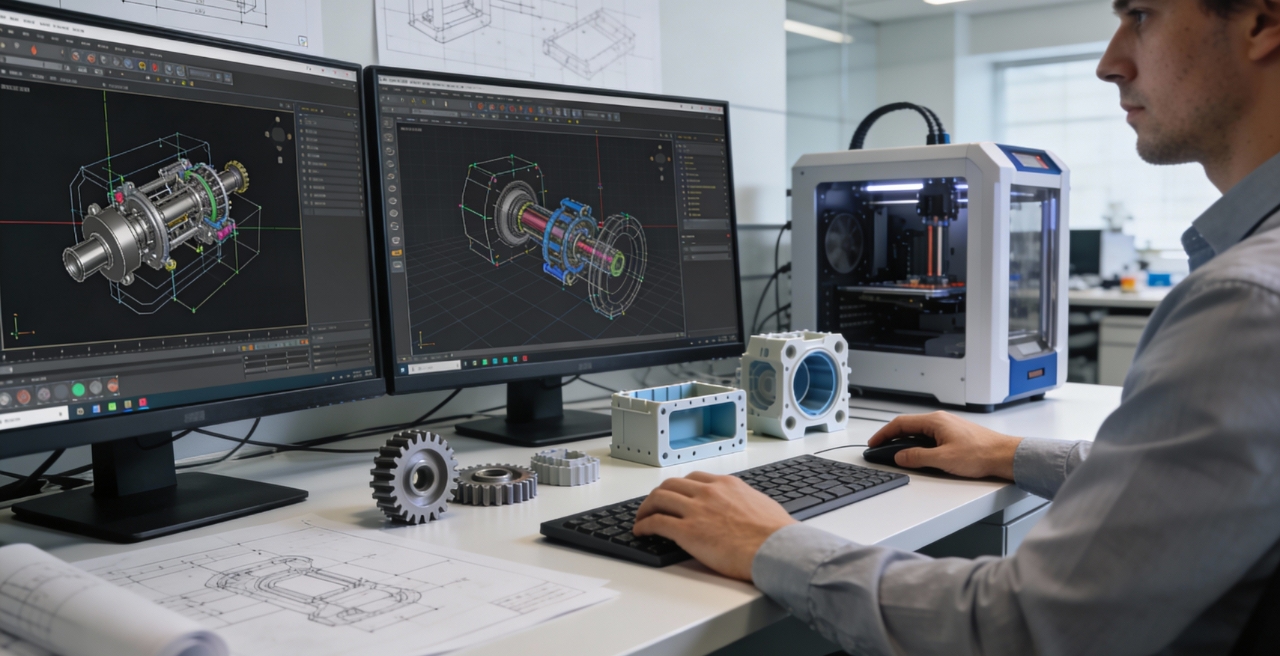
Creo Design Software is now a key tool for engineering teams facing the challenges of modern product development. As industries push for faster innovation, greater accuracy, and improved teamwork, engineers require solutions that keep pace without compromising their design objectives.
Creo meets these needs by offering strong 3D CAD features, scalability, high performance, and integration throughout the product lifecycle.
Product engineering these days isn’t linear anymore. It needs to be able to change designs quickly as requirements change, and to be both flexible and precise. This is where Creo always shows its usefulness.
Creo Design Software and the Shift in Modern Product Engineering
There has been a big change in product engineering. Integrated workflows have replaced traditional, separate design processes. In these new workflows, design, validation, and manufacturing are all closely linked.
Creo Design Software supports this change by allowing engineers to work confidently in environments that need:
- Faster design iterations
- Greater product complexity
- Cross-functional collaboration
- Reduced time-to-market
Creo helps teams get from idea to production faster by ensuring that design tools align with the needs of real-world engineering.
Parametric and Flexible 3D CAD Capabilities
The way Creo does parametric modelling is one of the things that sets it apart from other companies. Engineers can clearly state their design intent, ensuring that any changes made at any stage automatically propagate throughout the model.
This flexibility allows teams to:
- Modify dimensions without rebuilding models
- Maintain consistency across assemblies
- Reduce manual rework and errors
In today’s product engineering, design changes are common, so using parametric CAD is an important way to improve productivity.
Built for Complex and Large-Scale Product Design
As products become more complex, engineering software needs to handle them without slowing down. Creo is made for advanced mechanical design tasks, such as working with large assemblies and complex shapes.
Engineering teams benefit from:
- Stable performance with large datasets
- Advanced surface and solid modelling
- Specialized tools for sheet metal, plastics, and composites
This is why Creo is a reliable option for industries that need to develop complex, high-precision products.
Integrated Simulation and Design Validation
Simulation now plays a key role in engineering. By validating designs early, teams can find problems before production starts.
Creo enables simulation-driven design by allowing engineers to:
- Validate designs during early development stages
- Reduce dependence on physical prototypes
- Improve product reliability and performance
Engineers can make decisions more quickly and with greater confidence by integrating analysis into the design environment.
Seamless Collaboration and PLM Compatibility
Working together is crucial in distributed engineering. Creo helps by making it easy to share data and connecting well with Product Lifecycle Management systems.
This ensures:
- Keep all your product data in one reliable place
- Help your design, manufacturing, and quality teams work together more smoothly
- Easily track your product at every stage
Maintaining this continuity is essential for organizations that aim for long-term engineering excellence.
Scalability for Startups to Large Manufacturing Enterprises
As engineering teams evolve, their software should keep up. Creo is designed to support businesses at every stage of growth.
Its modular structure allows teams to:
- Start with essential CAD tools
- Add advanced capabilities as needs expand
- Protect long-term software investments
Because it can grow, Creo is good for both new engineering teams and big manufacturing companies.
Industry Adoption Across Manufacturing Sectors
Many industries choose Creo for its accuracy and reliability. It also adapts well to different product engineering needs without affecting performance.
Common application areas include:
- Automotive and transportation
- Aerospace and defence
- Industrial machinery
- Consumer and high-tech products
Since many people use Creo, it comes across as a trustworthy and modern engineering solution.
Why Engineering Teams Continue to Choose Creo
Long-term value, not just features, guides engineering choices. Creo delivers many useful features that are easy to use.
Teams choose Creo for:
- Reliable performance under complex workloads
- Strong alignment with engineering workflows
- Proven return on investment over time
These qualities make Creo a reliable platform for creating new products.
Frequently Asked Questions
What industries benefit most from Creo Design Software?
Creo is very helpful for industries such as automotive, aerospace, industrial equipment, and consumer manufacturing because it can handle complex designs and support advanced engineering workflows.
Is Creo suitable for small and mid-sized engineering teams?
Yes, Creo’s modular and scalable structure is a good choice for small and medium-sized teams. They can start with the key tools and add more as their engineering needs change.
How does Creo support modern product development workflows?
Creo helps modern teams work more efficiently by offering parametric design, built-in simulation, and PLM compatibility. These features make it easier to iterate quickly, collaborate well, and create accurate designs.
Conclusion
As product engineering changes, engineering teams need tools that are flexible, fast, and dependable. Creo Design Software meets these needs by enabling complex designs, built-in validation, and scalability.
Creo is still the best choice for modern product engineering for companies that want to build products ready for the future.