

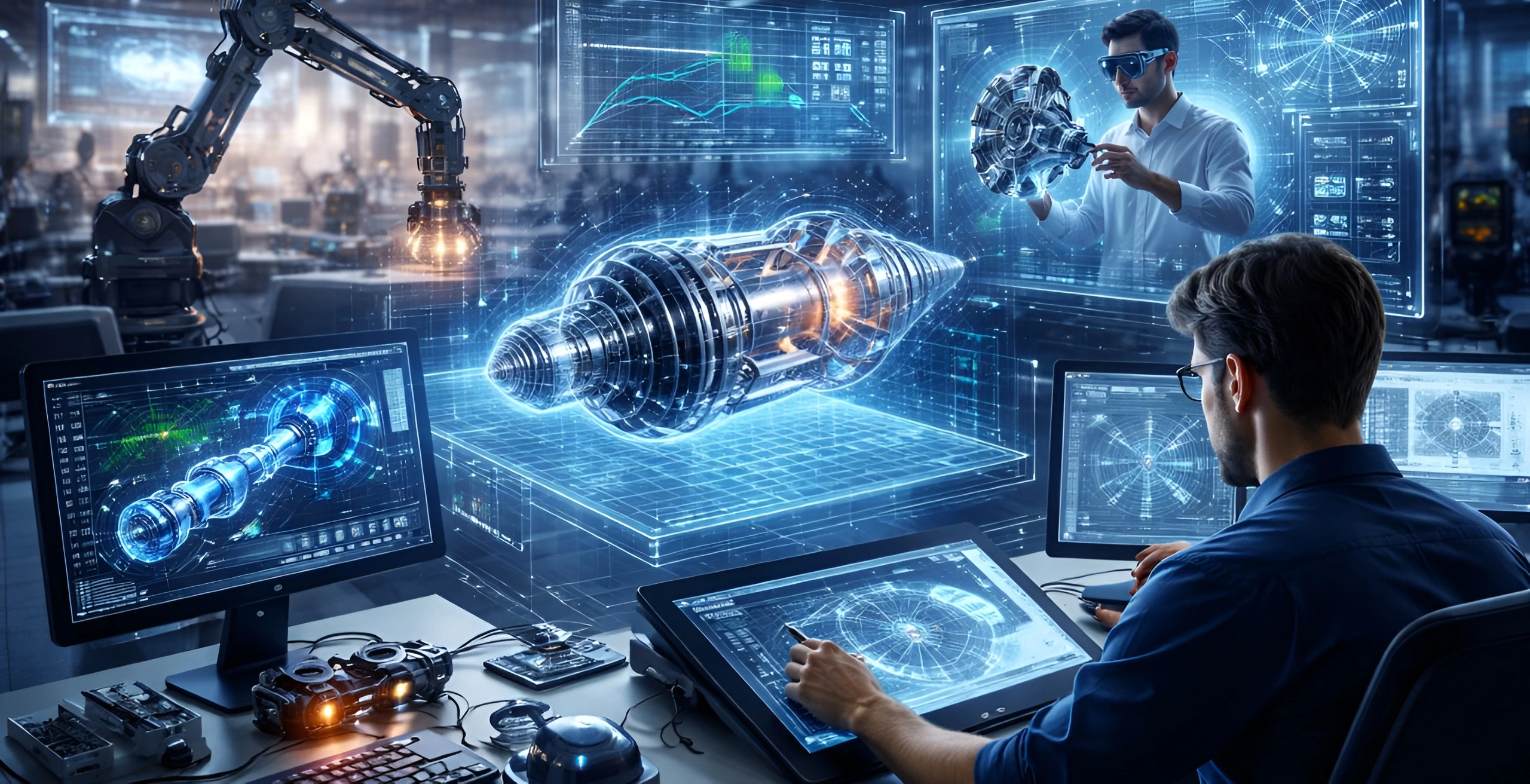
Digital engineering solutions are the primary catalyst for the modern industrial revolution. Integrated, data-driven workflows are replacing traditional design methods as global markets become more competitive.
These solutions enable companies to seamlessly transition from a creative concept to a high-performing, market-ready product. By leveraging a “digital thread,” businesses can ensure that information flows seamlessly from the initial sketch to the final production line.
In the current landscape, innovation is no longer just about aesthetics. It is about performance, sustainability, and speed. Digital engineering provides the framework to achieve all three. For manufacturers in India, adopting these technologies is the most effective way to reduce overhead while significantly boosting creative output and engineering precision.
Digital Engineering Solutions: The Core of Modern Product Development
To succeed today, a company must treat its design process as a unified ecosystem. Digital Engineering Solutions facilitates this by integrating Computer-Aided Design (CAD) with robust data management systems. This integration ensures that every stakeholder, from the lead engineer to the floor manager, is working with the most accurate, up-to-date information available.
The implementation of Product Lifecycle Management (PLM) is a critical step in this journey. Systems like Windchill act as a single source of truth, preventing the costly errors associated with version control issues.
Key Components of a Digital Workflow:
- Generative Design: Using PTC Creo to explore thousands of design iterations automatically based on set parameters.
- Cloud Collaboration: Enabling remote teams to work on complex assemblies in real-time without data lag.
- Data Consistency: This ensures that the manufacturing documentation instantly reflects changes in the 3D model.
- Photorealistic Rendering: Using KeyShot to create marketing-ready visuals before a physical prototype exists.
- Standardization: Reducing part variety to lower inventory costs and simplify the supply chain.
Accelerating Innovation through Simulation-Driven Design
The era of “build-and-test” is fading. Today, simulation-driven design allows engineers to validate their ideas in a virtual environment. This shift to Computer-Aided Engineering (CAE) means that performance testing happens alongside the design process, rather than after it.
By utilizing the Hexagon and MSC Software suites, such as Nastran and Adams, companies can simulate real-world physics with extreme accuracy. This proactive approach ensures that the first physical prototype is often the final one, saving immense amounts of time and capital.
Benefits of Early-Stage Simulation:
- Weight Reduction: Identifying areas where material can be removed without sacrificing structural integrity.
- Thermal Management: Predicting how electronic components will dissipate heat in compact enclosures.
- Durability Testing: Simulating years of mechanical wear and tear in just a few hours.
- Fluid Dynamics: Optimizing airflow or liquid movement through internal channels using Cradle CFD.
- Cost Efficiency: Drastically reducing the need for expensive physical crash or stress tests.
The Role of IIoT and AR in the Product Lifecycle
Modern innovation does not end when a product leaves the factory. The integration of Industrial IoT (IIoT) and Augmented Reality (AR) has introduced the concept of the Digital Twin. By connecting physical assets to digital models via ThingWorx, manufacturers gain real-time insights into how their products perform in the field.
Augmented Reality Applications:
- Interactive Manuals: Using Vuforia to provide technicians with 3D repair instructions overlaid on real machinery.
- Remote Assistance: Allowing experts to guide field operators through complex tasks via AR headsets.
- Design Reviews: Visualizing full-scale 3D models in a real-world office environment for better spatial understanding.
- Factory Planning: Mapping out production lines digitally to identify bottlenecks before moving heavy equipment.
Why Partner with Creotek India?
Finding the right partner is just as important as choosing the right technology. Creotek India serves as a premier PTC Creo reseller in India, providing localized expertise and world-class support. We specialize in helping businesses navigate the complexities of digital transformation.
Our Core Value Propositions:
- Authorized Partnership: Direct access to the latest tools from PTC, Hexagon, and Autodesk.
- Expert Consultancy: Tailoring software configurations to meet the specific needs of your industry vertical.
- Implementation Support: Reducing the learning curve for your engineering team through structured training.
- Process Optimization: Identifying gaps in your current workflow to improve overall operational efficiency.
- Scalable Solutions: Providing software packages that grow alongside your business requirements.
Conclusion
The future of engineering is digital, connected, and highly automated. By investing in digital engineering solutions, your organization can transform from a traditional manufacturer into a leader of innovation. Partnering with a specialist like Creotek India ensures that you have the tools, the knowledge, and the support to turn your most ambitious visions into reality.
Frequently Asked Questions (FAQs)
1. How do digital engineering solutions reduce time-to-market?
They allow for parallel processing where design, simulation, and manufacturing planning happen simultaneously. This eliminates the “silo” effect and identifies errors early, preventing late-stage design changes that typically cause delays.
2. Can these solutions integrate with existing legacy systems?
Yes. Most modern CAD and PLM platforms are designed with open APIs. This allows them to sync with existing ERP or legacy database systems, ensuring a smooth transition without losing historical engineering data.
3. What industries benefit most from CAD and PLM integration?
While every sector benefits, industries with high complexity-such as automotive, aerospace, industrial machinery, and medical devices-see the highest ROI due to the precision and regulatory compliance these tools provide.